- The Daily Vroom
- Posts
- Not Every “Sold” Car Actually Sells
Not Every “Sold” Car Actually Sells
PLUS: Bring a Trailer’s TV Push, Revisited

Sam Gold
January 27, 2026
The Daily Vroom
Good morning Vroomers,
No sales recap today. Instead, a quick look at something that happens behind the curtain of online auctions that rarely gets discussed, but probably should. Spend enough time around these platforms and you realize the story doesn’t always end when the listing flips to “sold.

The Part of Online Auctions We Don’t Really Talk About
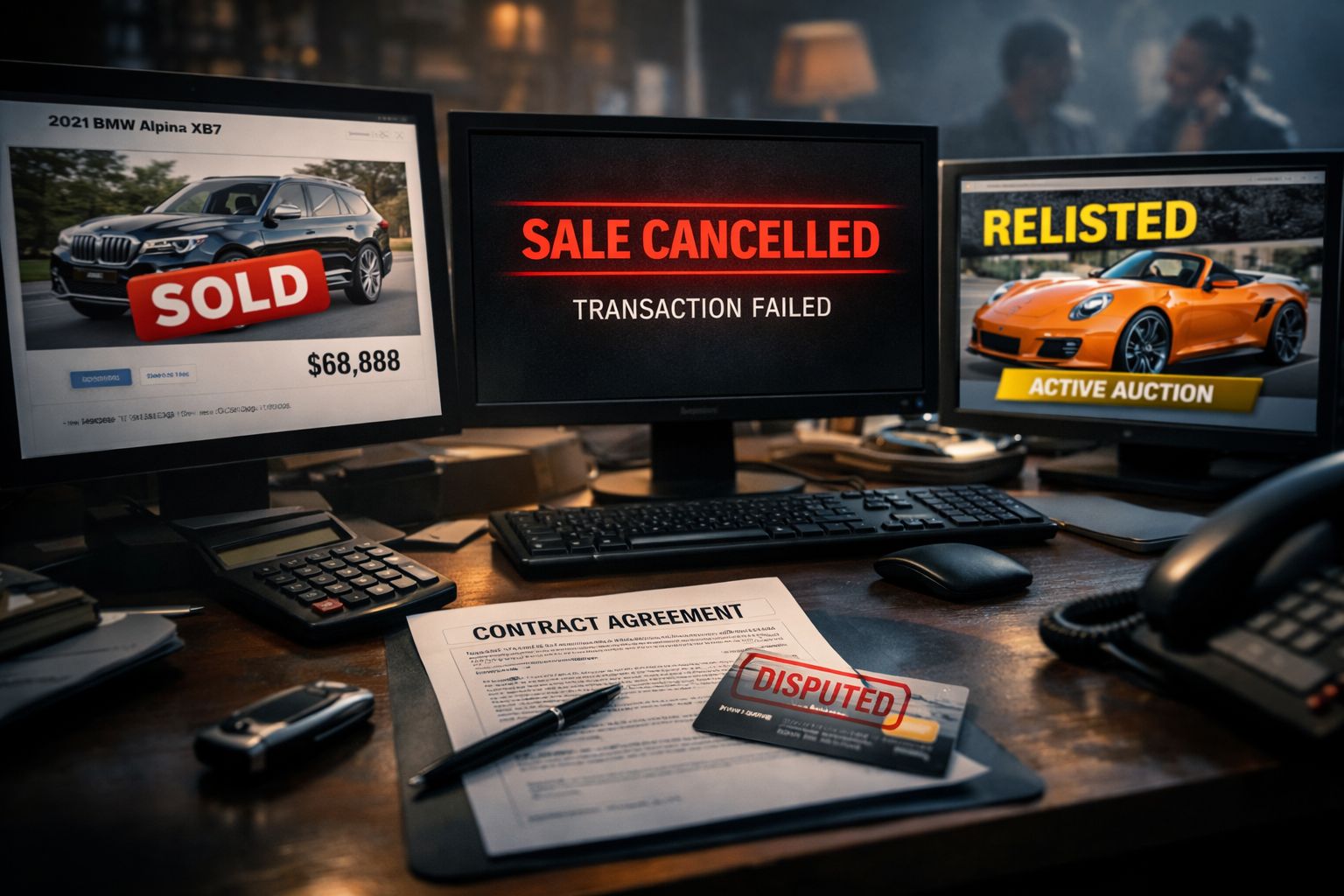
There’s a small but very real side of online auctions that rarely gets mentioned, mostly because it doesn’t fit the clean, satisfying narrative we like to tell about how seamless these platforms have become. From the outside, everything looks binary. A car either sells or it doesn’t. The listing flips to “Sold,” the result gets logged, and everyone moves on to the next auction.
In reality, that “sold” tag is sometimes just the beginning of a lot of behind-the-scenes work.
The vast majority of transactions close exactly as intended, and that’s worth saying up front. Considering that sites like Bring a Trailer, Cars & Bids, Collecting Cars, PCarMarket & others collectively process hundreds of vehicles a day, the completion rate is remarkably high. But when you operate at that kind of scale, even a small percentage of fallout starts to show up regularly. Deals fall apart. Buyers hesitate. Sellers second-guess themselves.
It happens more often than most people assume, particularly with no-reserve listings.
No reserve is great for liquidity and bidding confidence because it guarantees a result, but it also forces a moment of truth. Every now and then a seller watches their car hammer lower than expected and realizes, in real time, that they’re about to let something go for less than they had pictured in their head. The rational part of the brain knows that was the agreement. The emotional part sometimes wins. When that happens, the platform is left trying to enforce a commitment that, legally and contractually, should already be settled.
Buyers aren’t immune either. It’s easy to click one more bid late at night when the number still feels abstract. It feels very different the next morning when it’s time to wire tens of thousands of dollars. Most follow through without issue, but a small group inevitably disappears or disputes the charge. Yes, platforms can collect the buyer’s fee, but even then you’re often dealing with chargebacks and credit card disputes that drag things out and occasionally succeed. None of this shows up publicly. From the outside, the car just looks “sold.”
Two recent examples illustrate how this plays out in practice.
On Cars & Bids, a clean, one-owner 2021 BMW Alpina XB7 (which we wrote about last week) sold for $68,888, which was a pretty good result for both, all things considered. The auction closed, the winner was declared, and everything appeared normal. Behind the scenes, however, the seller ultimately refused to complete the transaction. Cars & Bids stepped in, tried to salvage the deal, and when the seller still backed out, permanently banned them from the platform. It’s not dramatic or exciting, but it’s exactly what you want to see. The entire model depends on commitments meaning something, and if sellers can simply walk away without consequence, trust evaporates quickly.
On the flip side, PCarMarket recently relisted a 991 Turbo S Cabriolet almost immediately after a winning bidder failed to complete the purchase. Instead of letting the car linger in limbo or quietly disappear, they put it right back in front of the market (ending today) and kept the momentum going. That’s the other side of good marketplace hygiene. Defaults happen. The key is minimizing disruption and getting the car back in play as quickly as possible.
None of this is meant as criticism of the platforms. If anything, it’s a reminder of how much coordination goes on behind the curtain to keep things functioning smoothly. Human behavior doesn’t suddenly become perfect just because the auction moved online. People still get cold feet. They still overbid. They still regret decisions. The difference now is simply that the cleanup happens privately while the public-facing interface stays tidy.
What separates strong platforms from weak ones isn’t whether deals occasionally fall through. At scale, that’s inevitable. The difference is how consistently and decisively those situations are handled. Ban the bad actors, protect the other side of the transaction, and keep liquidity moving. The faster a failed deal is resolved and the car is back on the market, the less damage it does to overall confidence.
For buyers and sellers, it’s also a useful reminder that these auctions are real transactions, not just entertainment. When you bid or list, you’re not participating in a game. You’re entering into a commitment that affects another person on the other side of the screen.
Most of the time everything works exactly as advertised. Every now and then it doesn’t. And when it doesn’t, there’s usually a lot more happening behind that simple “sold” badge than anyone realizes.

Bring a Trailer’s TV Push, Revisited
After yesterday’s article on Bring a Trailer’s TV push, I asked what you all thought the real objective was. The answers were remarkably aligned. Most of you didn’t see it as a splashy brand exercise or some victory lap. You saw it for what it is: simple marketplace math. More buyers and more sellers at the same time.

A few people put it bluntly. More buyers without more cars leaves them empty-handed. More sellers without bidders leaves them unhappy. The only way everyone wins is when both sides grow together. Which is exactly what TV is built for.
But stepping back, what’s interesting is that BaT isn’t hiding the strategy either.
When they launched the campaign, Randy (founder) described BaT as “more than just a platform… a destination for community, discovery and inspiration.” Hearst framed it similarly, positioning the ads as a way to introduce the auction experience to a broader, more mainstream audience.
That language matters. Notice what they’re not saying. There’s no “list today” or “sell faster.” It’s not transactional. It’s emotional. They’re selling belonging, not inventory.
That’s not performance marketing. That’s category leadership.
And it only makes sense if the goal is bigger than squeezing a few more listings out of the existing base. It’s about reaching the huge group of car people who still haven’t entered the online auction world at all.
Another thing worth remembering: this isn’t a short test. These ads have been running for over six months. At this level of spend, campaigns don’t survive that long unless the numbers back them up. If they’re still on air, it’s because more people are showing up and participating. Simple as that.
Several longtime users also pointed out the inevitable tradeoff. As platforms scale, the experience changes. Volume increases. The mix broadens. The early “can’t wait to see what’s listed today” feeling gets diluted. That’s the cost of growth. You don’t get to be both boutique and dominant forever.
BaT has clearly decided they’d rather be dominant.
And maybe that’s the real takeaway here. This isn’t a company defending its position. It’s one that already leads the market and still thinks there’s plenty left to capture.
If the leader at $1.7 billion a year is still investing aggressively to widen the funnel, the lesson isn’t that everyone else should rush out and buy TV spots. It’s that complacency is expensive. In this market, standing still is the same as shrinking.
Enjoying The Daily Vroom?
Pay it forward by sharing this newsletter with an automotive aficionado in your circles. Your endorsement allows us to accelerate our growth.
Send them to thedailyvroom.com to subscribe for free.
Reply