- The Daily Vroom
- Posts
- This Baja 964 Just Broke The “Modified Porsche” Logic
This Baja 964 Just Broke The “Modified Porsche” Logic
PLUS: What happens after the auction is met with a RNM

Sam Gold
March 19, 2026
The Daily Vroom
Auction of The Day

This ‘thing’ being at $400k+ already is kind of the whole story.
Because if you look at it quickly and just see a modified 964, the number makes no sense. But the second you actually understand what it is, it starts to click why people are stepping in.
It’s not a build in the normal sense. This is one of the original Russell Built cars, full Baja setup, Rothsport 3.8, proper suspension, tube chassis, the whole thing done properly, not just for show.
And that matters more than people think. You can see the split as well. Some people still look at this and just see a cut-up 911 and can’t get past that. Others look at it and see something that does something no other car they own can do.
That’s really what this comes down to. The $850k build cost they’re throwing around helps, obviously. Whether you fully buy it or not, it makes $400k+ feel a bit less crazy, because now you’re thinking about it as a shortcut rather than just a price.
From my side, I don’t even think this is a “is it worth it” conversation.
This is just one of those cars where if you’re the buyer, you already decided a while ago you want something like this, and when the right one shows up, you go.
Only thing I’d say is I wouldn’t suddenly treat this as the market for all of them. Cars like this don’t trade enough for that. Sometimes it’s just two guys deciding they both need it. Should be a fun end to this one.

After The Auction That Doesn’t Sell
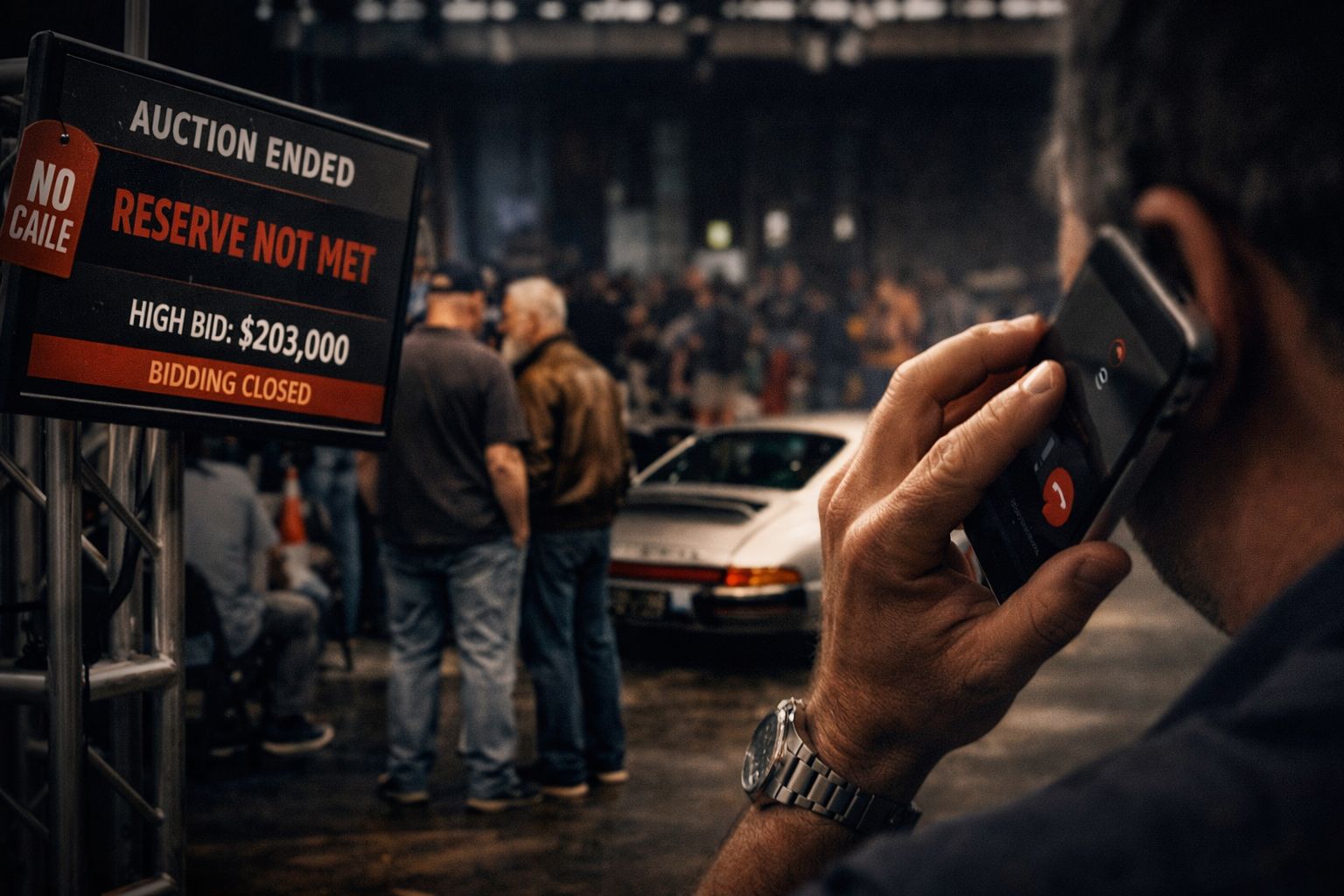
The auction ends, the timer hits zero, and the result flashes up as reserve not met, which for most people feels like a clean ending where the car didn’t sell and the market has spoken, and then attention shifts straight to whatever is coming next. That’s how it looks from the outside, but it’s not really how it works once you’ve actually been involved in a few of these.
What happens after a failed auction is easily one of the most overlooked parts of the market, and in a lot of cases it’s where the real deal actually gets done, just without the audience, the comments, or the pressure that comes with the auction itself. The public part gives you a number, but it doesn’t always give you the outcome.
You saw it the other day with that 1974 Carrera 2.7 MFI I wrote about earlier in the week, where going into the close everyone had the same rough number in their head somewhere around $240/250k which made sense based on how the car was presented and how those cars are usually talked about.
It got to $203k and stopped, reserve not met, and that’s where most people stopped paying attention.
A day later, the car actually sold for $215k, which is a very different number to the one people were comfortable saying out loud when it wasn’t their money involved, but it’s the only number that matters because it’s where two sides actually agreed once the auction noise disappeared and it became a real decision rather than a public one.
That’s the part people miss, or more accurately, the part they choose to ignore.
I’ve been on both sides of this enough times now that it becomes pretty obvious how the dynamic shifts once the auction ends, because I’ve bought cars after they didn’t sell and I’ve also had plenty of offers refused, which is completely fine and part of the process, but what’s consistent is how different the conversation feels once a real number has been established in public.
Before the auction, most sellers are anchored to what they think the car should be worth, which might be based on what they paid, what they’ve put into it, or what they’ve seen similar cars do in stronger moments, but after the auction they’ve now seen exactly where the market actually landed with real buyers, and whether they like it or not, that number is very hard to unsee.
From my side and I’m the highest bidder, the platform will have reached out to me (manually or automatically) and once I’ve given my top price, the response is almost always some version of “let me think about it” or “I’ll sleep on it,” which sounds casual but is really the point where the seller is deciding whether they’re holding onto a number or actually trying to sell the car.
And more often than not, that conversation goes somewhere. Not always at the number you start with, and not always quickly, but I’d say roughly two out of three times a deal ends up getting done if both sides are serious, because once the auction has exposed the real number, it’s a lot harder to keep pretending it’s something else.
That doesn’t mean every seller moves, because there are plenty of situations where the gap is still too large or the seller has enough conviction to wait, and sometimes that works out if the car comes back to market in a better moment (which could be days later!) or in front of a different audience.
Other times it doesn’t, and the second attempt is quieter and the result is worse, which is just part of how unpredictable timing can be in this market.
The point is that a failed auction isn’t the end of anything, it’s just the moment where the public part stops and the real decision starts, and if you only look at the final bid you’re missing the part that actually determines whether the car changes hands.
Because the number you see on the screen tells you where the room stopped, but the number you don’t see is the one that tells you where the deal actually got done.
Enjoying The Daily Vroom?
Pay it forward by sharing this newsletter with an automotive aficionado in your circles. Your endorsement allows us to accelerate our growth.
Send them to thedailyvroom.com to subscribe for free.
Reply